

About the Centre
Where Students Start Doing the Real Work
Chandigarh University's answer to a gap everyone in the industry talks about: graduates who know the theory but have never run a live campaign, briefed a client, or shipped anything that mattered.
Why We Built It
The Gap Between a Degree and a Professional
Digital marketing changed faster than most curricula could follow. Then AI arrived and changed it again. A student can finish a marketing degree having never touched an ad manager, never written a prompt that had to work, never sat in a review where a client disagreed with them.
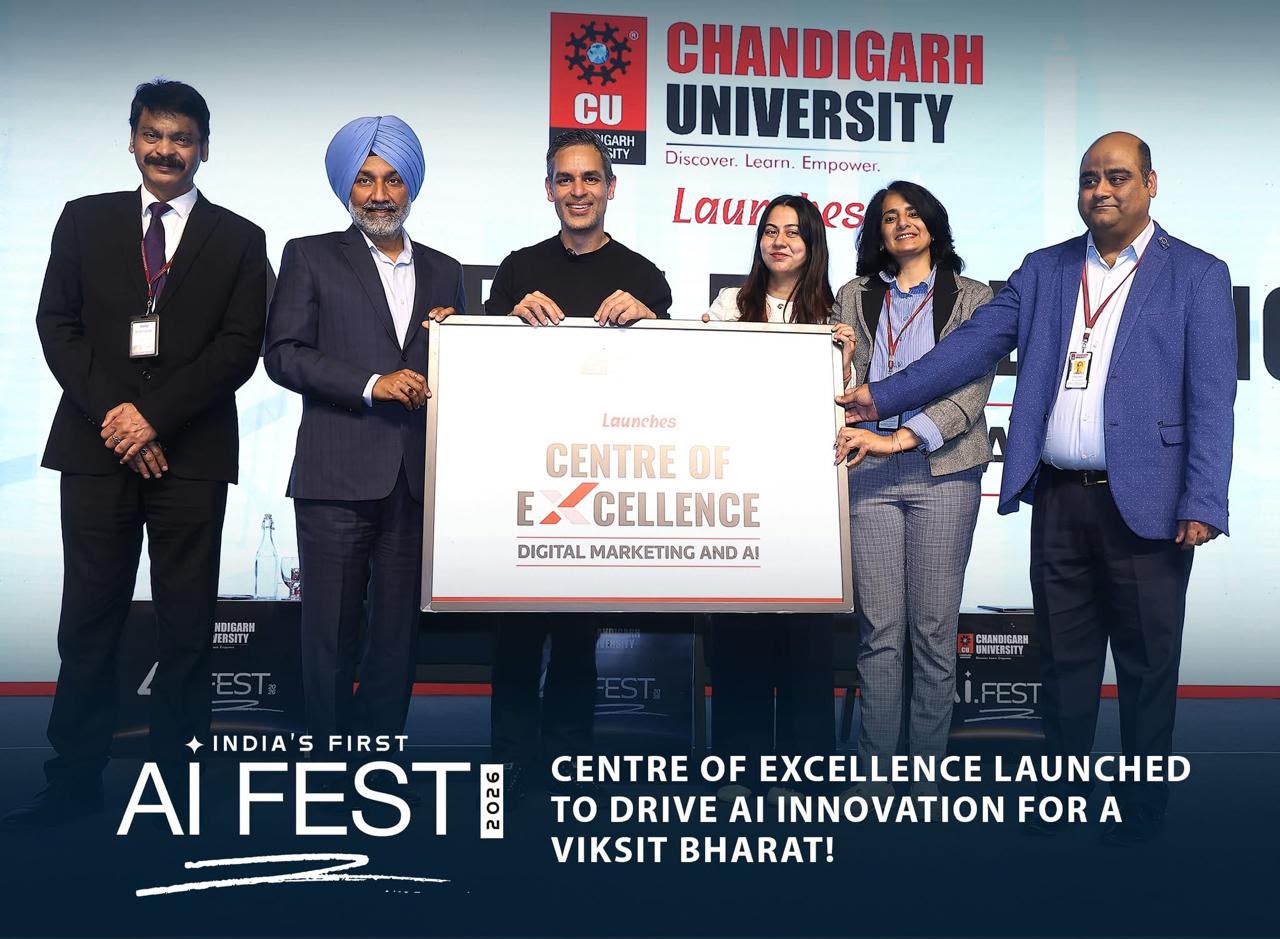
Chandigarh University established the centre as the first university-run centre in India dedicated specifically to digital marketing and AI. It sits inside the university but runs on industry timelines: live briefs, real deadlines, real consequences, under faculty who have done the work themselves.
The result is graduates who arrive at their first job already knowing what a Monday morning looks like.
What We Are Aiming At
Vision and Mission, in Plain Terms
Vision
That an institution in India can set the standard for how digital marketing and AI are taught, not by following what industry does, but by being close enough to it to help shape what comes next.
Mission
To give every student who passes through the centre genuine professional experience, and to give industry partners work they would have been happy to pay an agency for.
What Makes It Different
Six Things That Set This Apart From a Classroom
None of this is unusual in industry. Nearly all of it is unusual inside a university.
The clients are real
Work comes in through Xperiia Digital AI LLP, the centre’s enterprise arm. Businesses pay for the outcome, so the standard is set by them, not by a rubric.
Faculty work alongside students
Mentors are not grading from a distance. They sit in the same reviews, on the same deadlines, and are accountable for the same delivery.
AI is a tool, not a topic
Students use AI platforms the way practitioners do, for research, production, analysis and automation, and learn where it helps and where it quietly fails.
Everything gets written down
Each engagement ends in documentation that becomes teaching material, research input and a case study the student can show an employer.
It is tied to a national agenda
The work maps to India.ai, Viksit Bharat 2047 and NEP 2020, because the skills gap those policies describe is the one we are working on.
The four pillars feed each other
Training produces people for projects. Projects produce material for research. Research sharpens training. The experience centre shows the loop to visitors.
Inside the Centre
What a Term Looks Like
The same five stages run every cycle, for every intake.
- 01
Selected and trained
Intakes run through workshops and bootcamps covering platforms, tools and how an engagement works, before anyone touches a client account.
- 02
Briefs come in
Enquiries are scoped into projects with defined deliverables, timelines and a named faculty mentor who owns the relationship.
- 03
Teams form around the work
Students are matched to roles based on what the brief needs and what they are ready to take on.
- 04
Work ships and is reviewed
Delivery happens in cycles with client reviews along the way. Revisions are part of the process, not a failure of it.
- 05
Outcomes are documented
Results and lessons become case studies that feed teaching, research and the student’s own portfolio.
Why It Matters
Viksit Bharat 2047 is a calling for every institution.
The centre is Chandigarh University’s answer to it: not a statement of intent, but a working programme with clients, deadlines and documented outcomes.

Work with the centre
Bring Us a Brief, a Class or an Idea
Tell us what you are trying to do and we will point you at the right team.